Rafting in Rishikesh
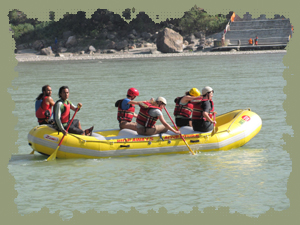 Well, to start with, lets look into the definitions of Rafting and its evolution. Wiki says “A raft is any structure, with a flat top, that floats on water. It is the most basic of boat design, characterized by the absence of a hull. Instead, rafts are kept afloat using any combination of buoyant materials such as wood, sealed barrels, or inflated air chambers.”
Traditional or primitive rafts are constructed of wood or reeds. Modern rafts may also use pontoons, drums, or extruded polystyrene blocks. Inflatable rafts use durable, multi-layered rubberized fabrics. Depending on its use and size, it may have a superstructure, masts, or rudders.
Timber rafting is used by the logging industry for the transportation of logs, by tying them together into rafts, and drifting or pulling them down a river. This method was very common up until the middle of the 20th century but is now used only rarely.
The type of raft used for recreational rafting is almost exclusively an inflatable boat, manufactured of flexible materials for use on whitewater. The modern raft is an inflatable boat, consisting of very durable, multi-layered rubberized or vinyl fabrics with several independent air chambers. The length varies between 3.5 m (11 ft) and 6 m (20 ft), the width between 1.8 m (6 ft) and 2.5 m (8 ft). The exception to this size rule is usually the packraft, which is designed as a portable single-person raft and may be as small as 1.5 metres (4.9 ft) long and weigh as little as 4 pounds (1.8 kg).
Rafts come in a few different forms. In Europe, the most common is the symmetrical raft steered with a paddle at the stern. Other types are the asymmetrical, rudder-controlled raft and the symmetrical raft with central helm (oars). Rafts are usually propelled with ordinary paddles and typically hold 4 to 12 persons. In Russia, rafts are often hand made and are often a catamaran style with two inflatable tubes attached to a frame. Pairs of paddlers navigate on these rafts. Catamaran style rafts have become popular in the western United States as well, but are typically rowed instead of paddled.
Whitewater is formed in a rapid, when a river’s gradient drops enough to form a bubbly, or aerated and unstable current. These days the term has a broader meaning applying to any river or creek that has a significant number of rapids and the term is also used to specify a kind of kayaking, canoeing or rafting on these rivers.
Coming on to whitewater rafting it is a challenging recreational activity using an inflatable raft to navigate a river or other bodies of water. This is usually done on white water or different degrees of rough water, in order to thrill and excite the raft passengers. The development of this activity as a leisure sport has become popular since the mid-1970s.
Classes of White Water Rafting
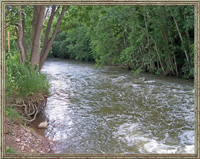 Class I: Easy. Waves small; passages clear; no serious obstacles.
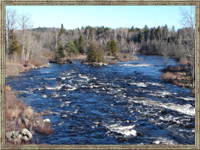 Class II: Medium. Rapids of moderate difficulty with passages clear. Requires experience plus suitable outfit and boat.
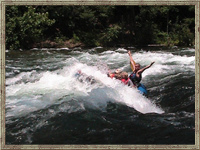 Class III: Difficult. Waves numerous, high, irregular; rocks; eddies; rapids with passages clear though narrow, requiring expertise in maneuvering; scouting usually needed. Requires good operator and boat.
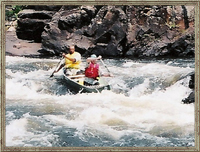 Class IV: Very difficult. Long rapids; waves high, irregular; dangerous rocks; boiling eddies; best passages difficult to scout; scouting mandatory first time; powerful and precise maneuvering required. Demands expert boatman and excellent boat and good quality equipment.
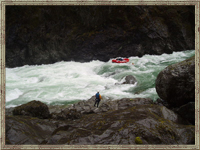 Class V: Extremely difficult. Exceedingly difficult, long and violent rapids, following each other almost without interruption; riverbed extremely obstructed; big drops; violent current; very steep gradient; close study essential but often difficult. Requires best person, boat, and outfit suited to the situation. All possible precautions must be taken.
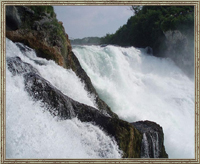 Class VI (or U) : Formerly classified as unrunable by any craft. This classification has now been redefined as unraftable due to people having recently kayaked mulitple Class VI around the world.
Rishikesh Water Rafting
You don’t have to be an expert swimmer to be able to experience the thrill of rafting. Especially when there is well equipped, expert team of friendly instructors with you around. You get to experience the sheer power of Ganges in a true adventurer style. A two day rafting expedition at Rishikesh with us would cover about 36 km of the river and you would return all full of the thrills of the rapids.
River Rafting Trips
An easy rafting tripcovers about 10-kms of river running. First drive to Brahmpuri, and then take a boat to ride the currents of the water of the Ganges. Raft down through the heart of Lachman Jhula, and Geeta Bhawan to Muni-Ki-Reti and witness the numerous ashrams, yoga and meditation institutes and bathing Ghats with pilgrims taking a holy dip in the Ganges river water. Rafting certainly presents a better way to witness Rishikesh – the town of temples, ashrams and the Ghats and above all only do rafting for thrill.
White Water Rafting
The Camp provides facilities of White Water Rafting covering rapids like Sweet Sixteen (Grade-1), Marine Drive (Grade-2), Three Blind Mice (Grade-3), Cross Fire (Grade-3), Roller Coaster (Grade-4) and Golf Course (Grade-4). Grade 4 rapids are undertaken depending upon the expertise of the rafter and the decision of the river guide. There are other rapids as well with as exotic names as above – Wall, Daniel’s Dip, Double Trouble, T-Off, Club House, Black Money etc.
River Rafting from Shivpuri
The best one to start with if you are brave enough. This 16 km stretch involves 7 rapids which includes one Grade IV and one Grade III rapids. Previous rafting experience will help though its not necessary. Kid’s should start with the Brahmapuri Stretch of 9 kms which does not have the Grade IV rapid. Excellent views all around and lots and lots of thrill is guranteed. The Roller Coaster will simply drive you crazy.
Rafting Season in Rishikesh
The suitable period for river running depends on the adequacy of water volume. Thus September-November and March-April-May are most appropriate. Most of the river established river camps near the on the Ganges above Rishikesh operate from the end of September to mid-December, and from mid-February until late April. Tour operators even arrange rafting excursions varying in length from one-day runs to extended camping-rafting expeditions, but advanced booking is required.
Grade of River Rafting in Rishikesh
Grade I – Relaxing – Waves are so small you may not even get wet.
Grade II – Easy does it – Clear passages and moderate waves.
Grade III – Adventurous – Lots of waterslide like waves, rapids with clean passages. Excellent family adventure!
Grade IV – Thrilling – Long rapids, powerful waves.
Grade V – Awesome – Long exciting rapids, big technical drops and steep gradient.
Grade VI – Don’t try this!!
(Grade V and Grade VI rapids are not undertaken for commercial rafting).
Personal Clothing Checklist(for Rafting Package)
T- shirts
Synthetic long sleeved T – Shirts for the river
Rafting sandals (rubber sandals with straps – easily available in all shoe stores very comfortable to wear around camp too)
Shorts / tights
Sun shade
Sunglasses with straps so that you don’t lose them.
Plenty of sunscreen
Light wool sweater/jacket to wear in camp in the evenings.
Flashlight
Misc. – reading/writing material
Personal toilet articles.
SEASON: mid Sept to mid December; mid January to end April.
RAFTING STRETCHES
Basic: Brahmpuri – 09 kms – II+ – 2 hrs – First timers/ Non-swimmers – Rs.400/-
Standard: Shivpuri -16 kms – III+ -3 hrs -First timers/ Non swimmers – Rs.550/-
Moderate: Marine Drive -25 kms – IV+ – 4 hrs – Swimmers with prior rafting – Rs.800/-
Advanced: Kaudiyala – 36 kms – IV, V – 6 hrs – Swimmers with prior rafting- Rs.1100/-
Just drop us an enquiry or call 9830788403.
Recent Entries
- New advance Rail ticket booking period reduced to 2 months from today
- Amarnath registration to start on March 18th
- Big Bird Day 2013
- Tour core tiger areas but don’t build: Supreme Court
- Interim ban on tourist activities in core areas of Project Tiger forests
- Tadoba on Red Alert
- The forgotten Silk Route – Jelep La
- National Park Status for Jaldapara
- Bouddha Bihar discovered at Dantan
- Melanistic Leopard Cat


February 26th, 2010 at 12:56 pm
[…] See more on rafting here. […]
February 28th, 2010 at 8:33 am
[…] Rafting in Rishikesh […]
March 2nd, 2010 at 10:43 am
[…] on River Teesta and Rangeet: (To know more on Grades, click here) Long Section Bardang to 29th Mile involves grade II, III, IV rapids and the approx. duration is 4 […]
March 5th, 2010 at 4:48 am
Of course, what a great site and informative posts, I will add backlink – bookmark this site.
Regards,
Reader.
March 21st, 2010 at 9:04 am
Keep posting good article.
June 1st, 2010 at 2:57 pm
Good Morning, your webpage design is really cool. I like how all the elements have been placed, and how the page is well structured so that it looks awesome.
July 14th, 2010 at 5:22 pm
Hi, i must say excellent blog you’ve, i stumbled across it in Bing. Does you get much traffic?
July 16th, 2010 at 1:40 pm
yes, we do.
August 24th, 2010 at 2:22 pm
Good writing.
August 26th, 2010 at 12:06 pm
Hi,
Very nice post. I will try it and already tried gangabeachresort.com
they also provided this type of services.
thanks
October 25th, 2010 at 12:57 am
After reading this blog, I honestly think that you have the exact idea of what are you talking about.I really want to applaud you for your passion towards your work that has helped you stand today at this stage.Genuinely,there has not been even a time that I have visited your post and went without getting some good information.Get Going.
November 27th, 2010 at 4:20 am
Great research. And very detailed information sharing.
Guys i went for rafting this year with http://www.roofnride.com. Check them out if they can be of help.
December 2nd, 2010 at 2:32 am
those polyurethane inflatable boats are very sturdy and some are kevlar lined too but they are expensive .:*
January 6th, 2011 at 4:13 am
centralhimalayanadventure@gmail.com– River Rafting in India
offers to the adventurous traveller to enjoy the thrill of
white water river rafting. The most popular rafting places
are Garhwal Himalayas in Uttarakhand. f you also want to
enjoy camping in rishikesh , stay in a riverside camp
situated on sandy beach or ganges. The camps at Rishikesh
are very much environmentally friendly – no detergent, no
plastic, no chewing gum and no electricity. Only gas
lanterns, tents and sandpits. People say rishikesh rafting
is most enjoyable river rafting in india.
January 24th, 2011 at 12:33 am
http://www.raftinginrishikesh4u.com- Rishikesh has become a
main hub of river rafting in Rishikesh, North India. It’s
an adventure sport best enjoyed at a white sand beach next
to the river. Rafting in Rishikesh, River Rafting in
Rishikesh, white water rafting in rishikesh, riverside
camping, camping in rishikesh and rishikesh rafting camps.
January 24th, 2011 at 10:41 am
~’: I am really thankful to this topic because it really gives up to date information ;,;
January 25th, 2011 at 5:11 am
Great article! htrurtye
December 11th, 2012 at 6:03 am
Rishikesh has established itself as the most favored places in India for white water rafting. River Rafting is, undoubtedly, the most exciting adventure sport in India. Any trip to India is incomplete until you get a taste of river rafting in the writhing waters of Ganges.
December 11th, 2012 at 8:56 pm
This is my first time pay a quick visit at here and i am really happy to read all at alone place.|
February 6th, 2013 at 4:27 am
I like the rafting.. I want to go for rafting in rishikesh in next week.
February 22nd, 2013 at 12:06 pm
call us at 9830788403
February 26th, 2013 at 1:02 pm
it was an awesome trip.. amaizing experience with river rafting in rishikesh and camping. tents were neat and clean food was good.. we stayed at beach camp no 5 itz location is very good they have beach made jus nxt to river ganga not like out camps which are slighly high … itz a bit down from road so car’s safety was minor concern as u r required to park on road. carry your eating and drinking stuff…
July 29th, 2013 at 4:36 am
It looks like an awesome destination for rafting. Thanks for the information. I love to know more about the place.
September 7th, 2013 at 6:53 am
Rishikesh has established itself as the most favored places in India for white water rafting. River Rafting is, undoubtedly, the most exciting adventure sport in India. Any trip to India is incomplete until you get a taste of river rafting in the writhing waters of Ganges and it is famous place for rafting in rishikesh.